Online Event Trotsky in Permanence 2021
Online
EditionsThe edition
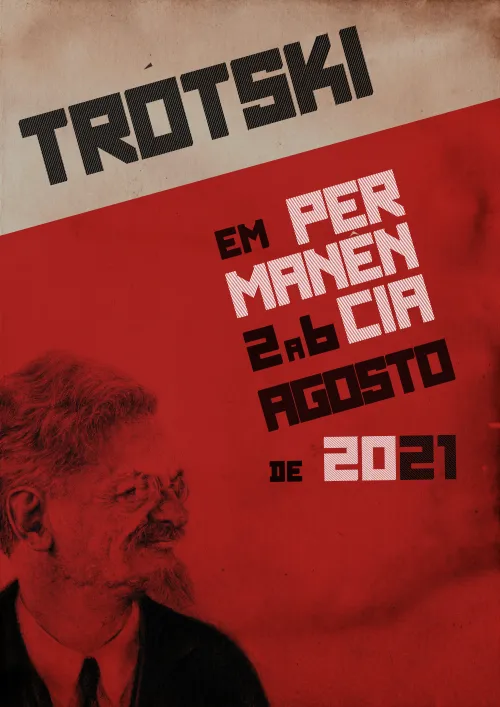
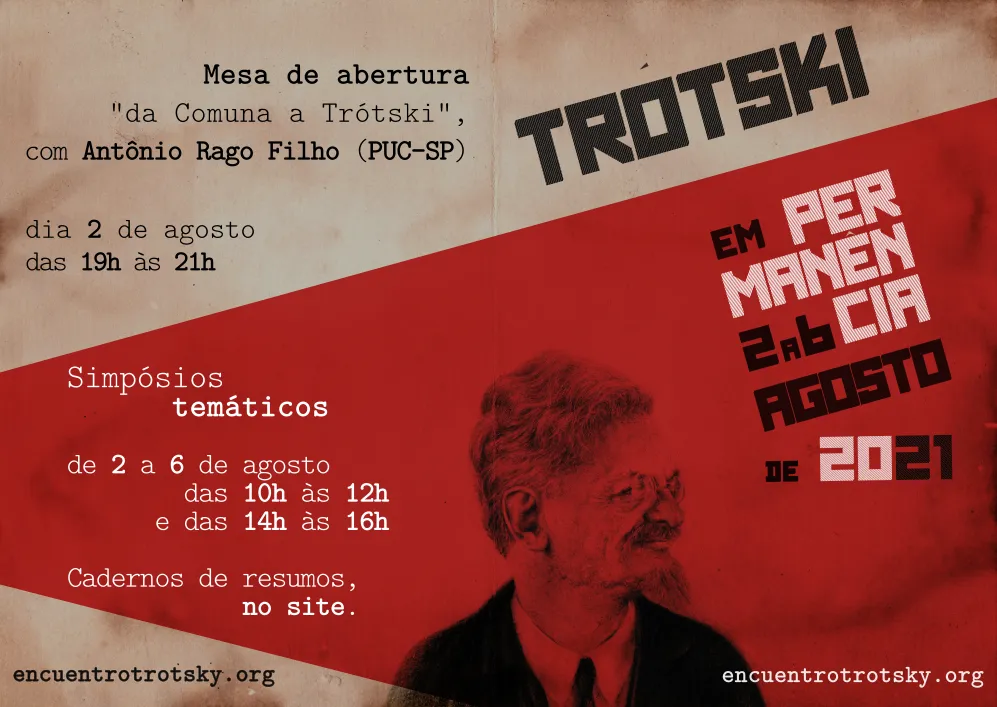
We are announcing the program of the 2021 edition of our online event! Please note that this is an initiative linked to the 2nd International Leon Trotsky Meeting, which is temporarily suspended because of the pandemic and will be organized as soon as the situation allows. [...] The event will feature an Opening Lecture (on the 2nd, at 7 p.m.), three Roundtables with guests (on the 3rd, 4th and 5th, at 7 p.m.) and ten Thematic Symposia with paper presentations on various topics related to Trotsky and Trotskyism (every day, from 10 a.m. to 12 p.m. and from 2 p.m. to 4 p.m.). [...] Please note that all times are Brasília time, GMT-3.
Posters05
Programme
- —
Day 2Monday, 2 August 2021
- Thematic symposium 1With videoThematic symposium 1
- Thematic symposium 2Thematic symposium 2
Day 3Tuesday, 3 August 2021
- Thematic symposium 3Thematic symposium 3
- Thematic symposium 4Thematic symposium 4
Day 4Wednesday, 4 August 2021
- Thematic symposium 5Thematic symposium 5
- Thematic symposium 6Thematic symposium 6
Day 5Thursday, 5 August 2021
- Thematic symposium 7Thematic symposium 7
- Thematic symposium 8Thematic symposium 8
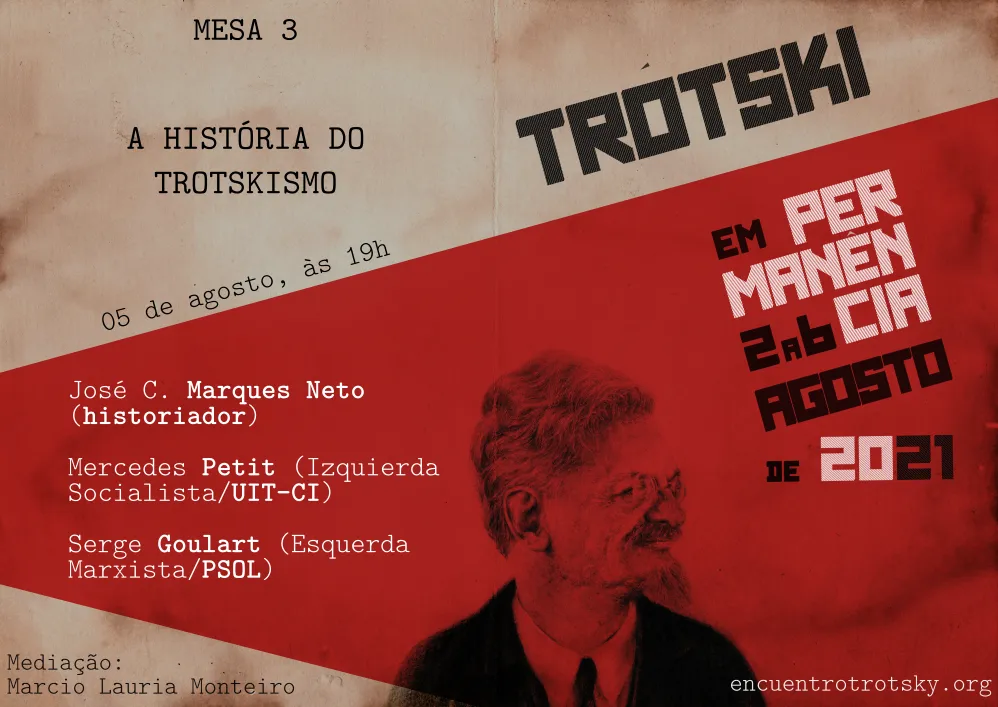
- Roundtable 3With videoThe history of TrotskyismJosé Castilho de Marques NetoMercedes PetitSerge Goulart
Day 6Friday, 6 August 2021
- Thematic symposium 9Thematic symposium 9
- Thematic symposium 10Thematic symposium 10
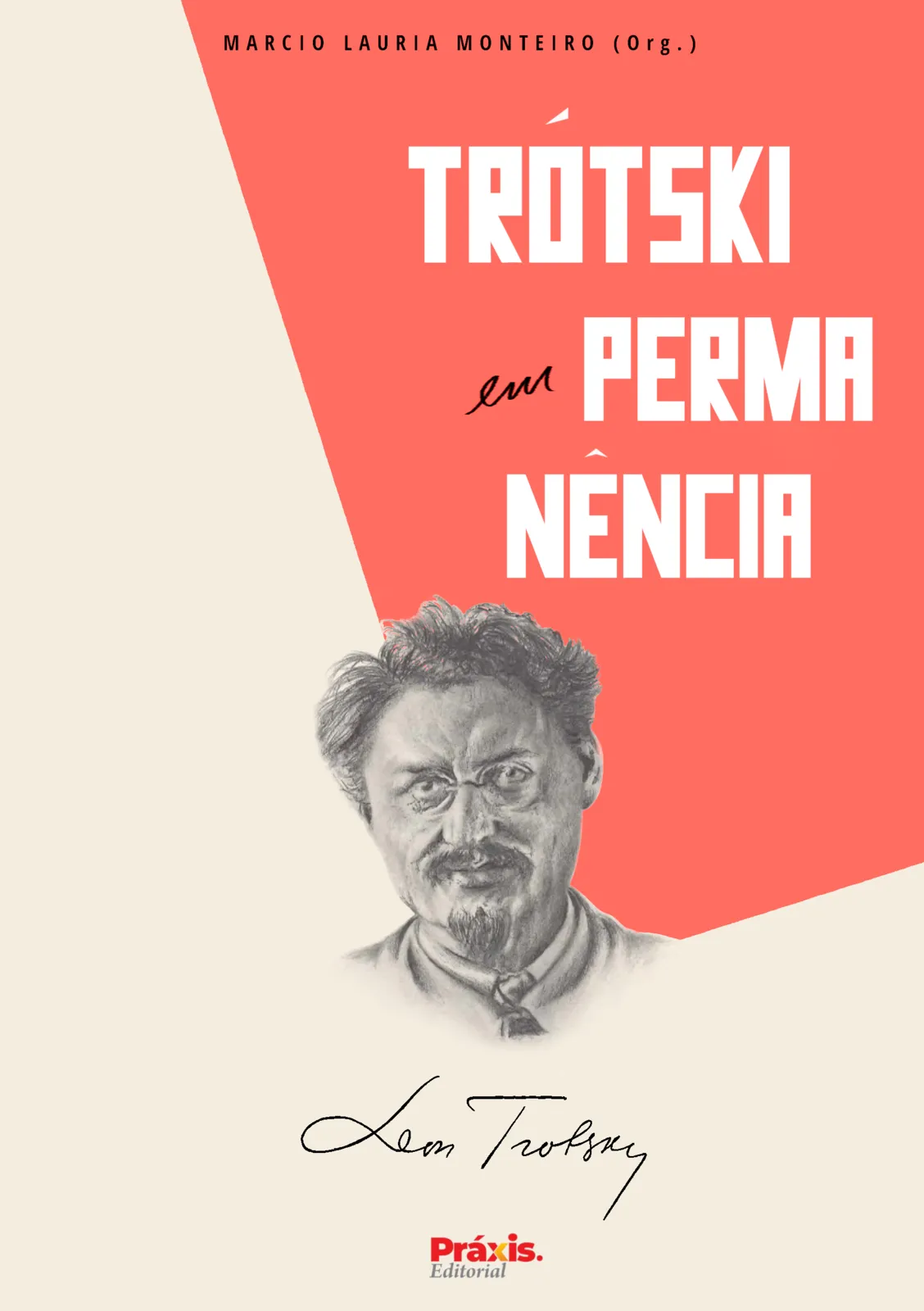
Trótski em Permanência 2021 (livro do evento)
Marcio Lauria Monteiro
25 textos; encerramento com contribuição de Frank García Hernández.
Book preface — Marcio Lauria Monteiro
Marcio Lauria Monteiro
One Opening Session and one Closing Session; four Roundtables, with a total of ten guests from seven different political organizations and three independents; ten Thematic Seminars, with a total of forty-one papers presented; people from seven different countries (Brazil, Argentina, the USA, Cuba, France, Greece and Colombia); some thirty hours of live broadcasts which, at the time of writing (June 2022), total around eight thousand five hundred views on YouTube. These are the figures of the Online Event Trotsky in Permanence 2021, held from 2 to 6 August, at a time when we were still living through the hardships of the COVID-19 pandemic, hence its online format.
It was very probably the largest event ever held devoted to Leon Trotsky and Trotskyism – at least in this format of roundtables and presentations of papers based on research work. The online format certainly contributed to the size of the event; this does not, however, detract from its merit, especially if we consider that it was held without any kind of financial support beyond voluntary contributions from some of the participants (to whom we are immensely grateful) and that it was publicized by “word of mouth”, although a few political organizations made a contribution by promoting the event on their websites and social media.
Regardless of these figures, however, what matters most was the outstanding quality of the debates held there, both in the Roundtables and in the Thematic Symposia – among the speakers as well as on the part of the audience, which participated actively through written questions and comments. Once the event was over, we organizers felt extremely satisfied with what we had achieved: the construction of a space for rich reflection on the legacy of Trotsky and Trotskyism.
The Roundtables were organized around themes that invited reflection on the current relevance of the legacy of Trotsky and Trotskyism, and gave priority to activists with reflections on these themes as guests, regardless of any affiliation with universities or research institutes:
– Opening Session, with Ântonio Rago Filho (PUC-SP, independent activist), who gave the lecture “From the Paris Commune to Trotsky”;
– Trotskyism today, with Diana Assunção (MRT), João Machado (Comuna/PSOL) and Vera Lúcia (PSTU);
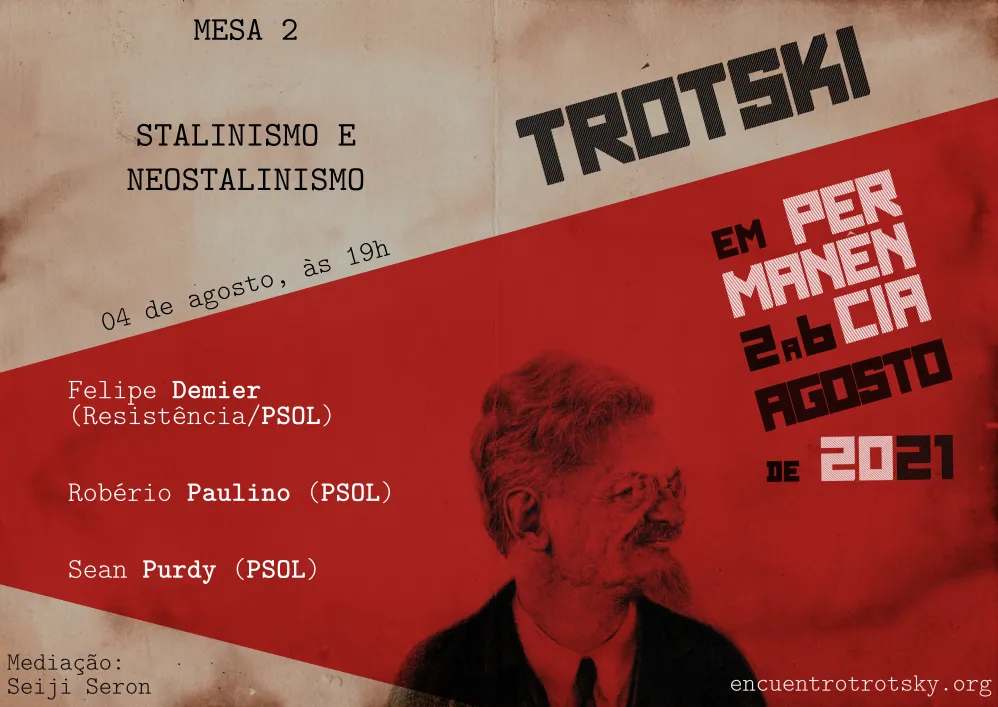
– Stalinism and neo-Stalinism, with Felipe Demier (Resistência/PSOL), Robério Paulino (independent within PSOL) and Sean Purdy (then independent within PSOL);
– History of Trotskyism, with José Castilho de Marques Neto (historian and independent activist), Mercedes Petit (UIT-CI) and Serge Goulart (Esquerda Marxista/PSOL);
– Closing Session, with Frank Hernandez García (Comunistas blog/magazine, Cuba), who spoke on “The situation in Cuba today”.
The Thematic Symposia, in turn, followed the same principle of prioritizing topics that brought reflections on Trotskyism to bear on the present, in order to avoid reflections detached from a concern with revolutionary praxis, and without requiring presenters to be affiliated with university or research institutions; to be selected, it was enough to have submitted a well-grounded proposal. The forty-one papers presented dealt with the most diverse topics connected with Trotsky and Trotskyism: the arts; education; science and technology; the national question; the trade union question; fascism and how to fight it; specific oppressions and the struggle against sexism and racism; questions of revolutionary strategy; the concept of Bonapartism; the theory of uneven and combined development and the theory of permanent revolution; the question of the workers' states and of Stalinism; the role of Trotskyists in revolutionary processes (Bolivia, Vietnam, Cuba, Portugal); the history of the Trotskyist movement in Brazil, in Argentina and internationally.
It should be stressed that this was a very politically plural event within the field of Trotskyism, both in the composition of the guest Roundtables and in that of the Thematic Symposia. Achieving this plurality was the organizers' intention from the outset. It could not have been otherwise, since the aim was to promote debates and reflections on the legacy of Trotsky and Trotskyism that would contribute to the necessary assessment of what has become of that legacy, which today is formally claimed by a myriad of small (often microscopic) national and international organizations that are very different from one another.
How did the initiative for the event come about? The Online Event Trotsky in Permanence had its first edition in August 2020. Initially, it was a way of making up, very partially, for the impossibility of holding the 2nd International Leon Trotsky Meeting, which had been scheduled for July of that year in São Paulo but was suspended because of the COVID-19 pandemic. That 2020 edition was considerably smaller, consisting of three Roundtables with some of the guests who had already confirmed their participation in the 2nd International Meeting. Given the success of that event and the continuation of the pandemic, we chose to hold a second, more ambitious edition in 2021.
The event originally planned for 2020 was, in turn, to be a continuation of the 1st International Leon Trotsky Meeting, held in Havana, Cuba, in May 2019. Promoted by Frank García Hernandez, a Cuban communist activist and researcher of the history of Trotskyism in Cuba, that event brought together people from several countries to debate the legacy of Trotsky and Trotskyism and its importance for understanding Cuban reality. A compilation of almost all the papers presented there can be found in the book Trotskismos em Cuba, Retrato de um Encontro, edited by Flo Menezes and published in 2021 as an e-book and made available in print in 2022, both by Nojosa Edições.
During the event in Cuba there was a rich exchange of experiences and knowledge among those present, permeated by the inevitable, healthy and necessary polemics surrounding the legacy of Trotsky and Trotskyism and the meanings of its current relevance as a guide for interpreting reality and for socialist revolutionary action. As a result of those exchanges, a group of Brazilians left the island with the task of organizing a second, even larger edition in São Paulo the following year.
When the pandemic began, the 2nd Meeting was already being organized, with confirmed guests for the Roundtables and almost fifty paper proposals, from six different countries, to be evaluated for the event's Thematic Symposia. It was the desire to keep the flame of the 1st Meeting alive and not to abandon entirely the plan to hold a 2nd that led to the organization of the 2020 and 2021 online events. The task was carried out by the Mário Pedrosa Organizing Committee, originally made up of the Brazilians who had met in Cuba and expanded over time.
With this publication, we hope to preserve and disseminate the memory of the 2021 Online Event and the many rich contributions that circulated in its ten Thematic Symposia. With this book we intend, as in the undertaking of organizing the event, to contribute humbly to the Herculean, yet unavoidable, task of reorganizing the revolutionary socialist forces. For, as the pandemic demonstrated once again, there are only two possible paths: socialist revolution or the barbarization imposed by capitalism.
There is no victorious revolution without a revolutionary party and program. Faced with the need to build them, assessing the legacy of the Soviet Revolution, the Left Opposition and the Fourth International is a fundamental step so that we do not start again from scratch. There is much to learn from the analyses, positions and battles of the revolutionaries who came before us – which in no way means a mechanical transposition of their legacy to the present, reducing it to ready-made formulas (nothing could be less dialectical than that, even if it is the path followed by many who claim to be Trotskyists).
The Fourth International has long ceased to exist, and those who claim its legacy hold very diverse positions, often contrary to its foundations, namely: a non-negotiable line of class independence; a programmatic method that falls neither into abstract maximalism nor into reformist economism (the method of the Transitional Program); proletarian internationalism as a political principle, analytical method and organizational form; the basic notion that the bourgeoisie has long been incapable of playing any revolutionary role, even in the capitalist periphery, so that it falls to the proletariat to carry out the pending “national-democratic” tasks in combination with properly socialist ones (the strategy of permanent revolution); the unconditional defense, against external or internal capitalist counterrevolution, of those social formations that originated in post-Second World War revolutions (the bureaucratized workers' states); and the defense of political revolution against the bureaucratic dictatorships established in those social formations.
We hope that, with the Online Event Trotsky in Permanence, we have contributed in some measure to the recovery, critical assessment and application to the present of these and other fundamental contributions of Trotsky and Trotskyism.
Long live Leon Trotsky!
Long live revolutionary socialism!
N.B.: Throughout this book Trotsky's name is spelled in different ways (Trótski, Trotsky, Trotski, etc.). We chose to preserve the spelling chosen by each author rather than impose standardization, since the multiple spellings do not hinder understanding and there is, in fact, no recognized and well-established standard, even though there are transliteration rules (which, incidentally, if followed, lead to a spelling quite unusual for Brazilian readers).